Show your support for the Connexion by purchasing a playbill ad, calendar notice or mention. The playbill will be distributed at 15 events from October 28 through November 15! Reserve your ad or mention HERE.
Join us for the Chicago Paris Cabaret Connexion!! This is an international gathering of singers, teachers, and music lovers taking place in Chicago November 2-8, 2026! Meet new friends, see a cabaret show, take a workshop, or sit in on a free round table. With over 25 workshops, a dozen performances, and daily round table discussions, there is something for everyone!
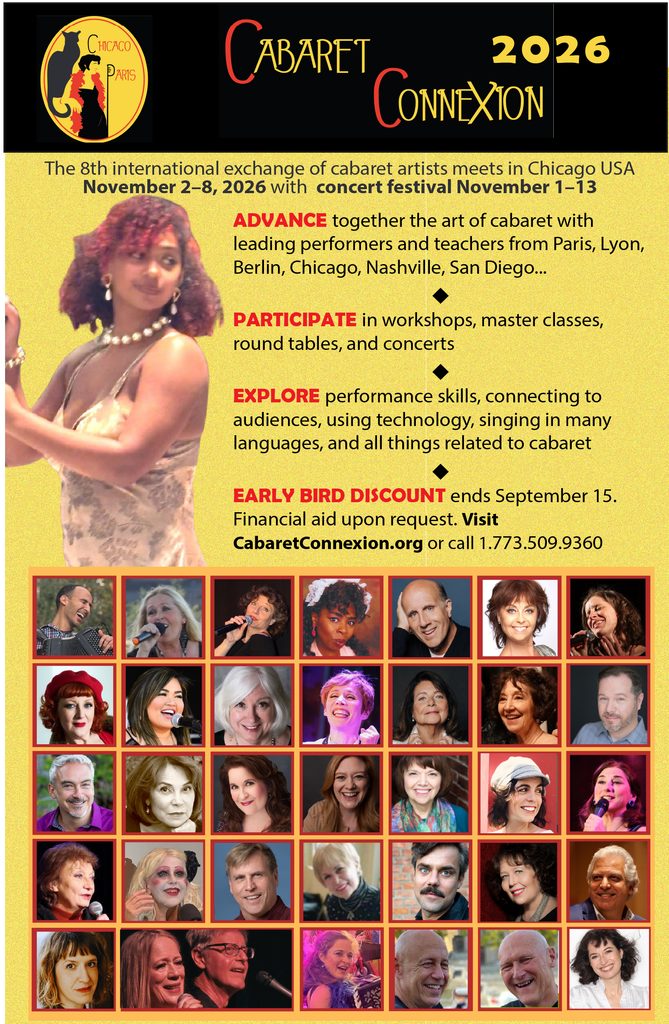
Teachers and performers hail from Paris, Chicago, San Diego, Lyon, Nashville, and Las Vegas offering the very best of personalized coaching. From multiple backgrounds – opera, cabaret, blues, jazz, pop, french chanson and more!
Many Ways to participate:
- Attend the full conference and perform in a showcase
- OR
- Dip your toe in – Take one class
- Attend one full day of classes and workshops
- Attend five 3-hour blocks to perform in a showcase
- Build your own schedule
- Join the free lunchtime Round Table discussions to explore the world of cabaret
- Buy the Connexion Passport for tickets to 11 shows and events
- Volunteer to house a visiting performer
- Donate a scholarship for someone who wants to learn
Need more info? Get in touch at 773-509-9360, Claudia@workiningconcert.org
Follow 2 steps to attend the Cabaret Connexion follow:
1. REGISTER for Cabaret Connexion 2026
2. SIGNUP for your preferred individual workshops and master classes (first come-first serve)
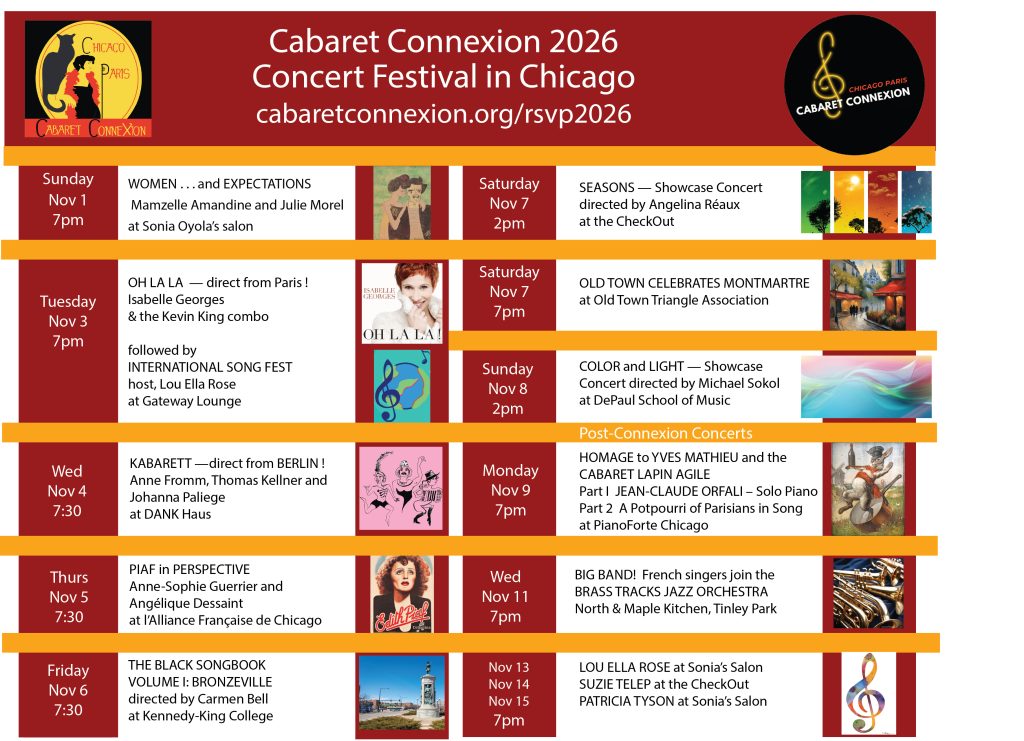
* connotes a CPCX Passport show (purchase yours for $295)
- Friday, October 30, Lyonnais artists perform at University of Wisconsin-Milwaukee
- * Sunday November 1, 7 PM at Sonia Oyola’s House : Mamzelle Amandine & Julie Morel present Women and Expectations
- * Monday November 2, 6 PM Meet & Greet at DANK Haus
- * Tuesday November 3, 7 PM Isabelle Georges’ Oh là là ! followed by International Song Jam at the Gateway Lounge
- * Wednesday November 4, 7 PM A Brief History of Berlin Kabarett concert at DANK Haus with Anne Fromm, Thomas Kellner, and Johanna Paliege
- * Thursday November 5, 7:30 PM Piaf in Perspective at l’Alliance Française de Chicago, featuring Anne-Sophie Guerrier and Angélique Dessaint
- * Friday, November 6, 7:30 PM The Black Songbook Volume I: Bronzeville at Kennedy-King College
- * Saturday November 7, 2 PM Seasons —a showcase concert at the CheckOut
- * Saturday November 7, 7 PM Old Town Celebrates Montmartre at the Old Town Triangle Association
- * Sunday November 8, 2 PM Color and Light —a showcase concert at DePaul School of Music
The Post-Connexion Festival continues with
- * Monday November 9, 7 PM Homage to Yves Mathieu’s Cabaret Lapin Agile: Part I-solo piano by Jean Claude Orfali; Part II- a concert of French songs.
- * Wednesday November 11, 7 PM French singers join the Brass Tracks Jazz Orchestra at North & Maple Kitchen in Tinley Park
- POST-CONNEXION SOLO SHOWS
- Saturday, November 14: Suzie Telep at the CheckOut
- Sunday, November 15: Patricia Tyson at Sonia’s Salon
- Saturday, November 21, 7 PM Lou Ella Rose at Sonia’s house concert
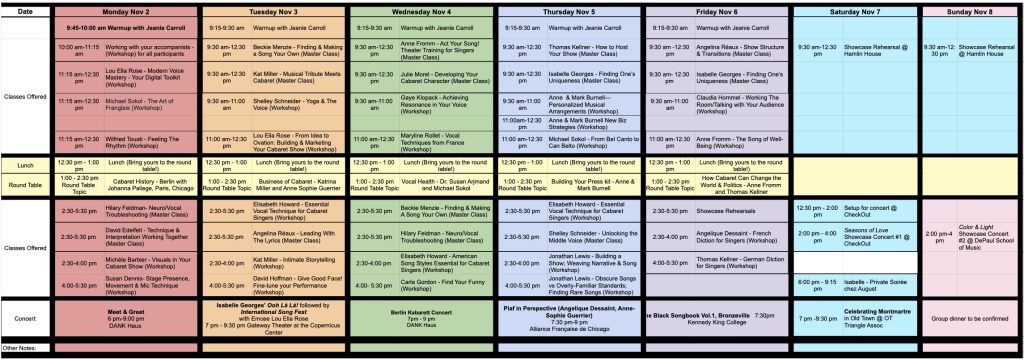
| Monday Nov 2 | |
| 9:15-9:45 am Check in | |
| 9:45-10:00 am Warmup with Jeanie Carroll | |
| 10:00 am-11:15 am | Jean-Claude Orfali et al: Working with your accompanists – (Workshop) for all participants |
| 11:15 am-12:30 pm | Lou Ella Rose – Modern Voice Mastery – Your Digital Toolkit (Workshop) |
| 11:15 am-12:30 pm | Michael Sokol – The Art of Franglais (Workshop) |
| 11:15 am-12:30 pm | Wilfried Touati – Feeling The Rhythm (Workshop) |
| 12:30 pm – 1:00 pm | Lunch (bring yours to the round table!) |
| 1:00 pm- 2:30 pm | Round Table Topic: Cabaret History – from Paris to Chicago to Berlin |
| 2:30 pm-5:30 pm | Hilary Feldman– Neuro/Vocal Troubleshooting (Master Class) |
| 2:30-5:30 pm | David Edelfelt – Technique & Interpretation Working Together (Master Class) |
| 2:30-4:00 pm | Michèle Barbier – Visuals in Your Cabaret Show (Workshop) |
| 4:00-5:30 pm | Susan Dennis– Stage Presence, Movement & Mic Technique (Workshop) |
| Meet & Greet 6 pm-9:00 pm DANK Haus | |
| Tuesday Nov 3 | |
| 9:15 am-9:30 am | Warmup with Jeanie Carroll |
| 9:30 am-12:30 pm | Beckie Menzie – Finding & Making a Song Your Own (Master Class) |
| 9:30 am-12:30 pm | Kat Miller – Musical Tribute Meets Cabaret (Master Class) |
| 9:30 am-11:00 am | Shelley Schneider – Yoga & The Voice (Workshop) |
| 11:00 am-12:30 pm | Lou Ella Rose – From Idea to Ovation: Building & Marketing Your Cabaret Show (Workshop) |
| 12:30 pm – 1:00 pm | Lunch (Bring yours to the round table!) |
| 1:00 pm – 2:30 pm | Round Table Topic: Business of Cabaret – Katrina Miller and Anne Sophie Guerrier |
| 2:30 pm-5:30 pm | Elisabeth Howard – Essential Vocal Technique for Cabaret Singers (Workshop) |
| 2:30 pm-5:30 pm | Angelina Réaux – Leading With The Lyrics (Master Class) |
| 2:30-4:00 pm | Kat Miller – Intimate Storytelling (Workshop) |
| 4:00-5:30 pm | David Hoffman – Give Good Face! Fine-tune your Performance (Workshop) |
| Isabelle Georges’ Ooh Là Là! followed by International Song Fest (emcee Lou Ella Rose) 7:00 pm-9:30 pm Gateway Theater at the Copernicus Center | |
| Wednesday Nov 4 | |
| 9:15-9:30 am | Warmup with Jeanie Carroll |
| 9:30 am-12:30 pm | Anne Fromm – Act Your Song! Theater Training for Singers (Master Class) |
| 9:30 am-12:30 pm | Julie Morel – Developing Your Cabaret Character (Master Class) |
| 9:30 am-11:00 am | Gaye Klopack – Achieving Resonance in Your Voice (Workshop) |
| 11:00 am-12:30 pm | Maryline Rollet – Vocal Techniques from France (Workshop) |
| 12:30 pm – 1:00 pm | Lunch (Bring yours to the round table!) |
| 1:00 pm- 2:30 pm | Round Table Topic: Vocal Health – Dr. Susan Arjmand and Michael Sokol |
| 2:30-5:30 pm | Beckie Menzie – Finding & Making A Song Your Own (Master Class) |
| 2:30-5:30 pm | Hilary Feldman – Neuro/Vocal Troubleshooting (Master Class) |
| 2:30-4:00 pm | Elisabeth Howard – American Song Styles Essential for Cabaret Singers (Workshop) |
| 4:00- 5:30 pm | Carla Gordon – Find Your Funny (Workshop) |
| A Brief History of Berlin Kabarett concert 7:00-9:00 pm DANK Haus | |
| Thursday Nov 5 | |
| 9:15 am-9:30 am | Warmup with Jeanie Carroll |
| 9:30 am-12:30 pm | Thomas Kellner – How to Host Your Show (Master Class) |
| 9:30 am-12:30 pm | Isabelle Georges – Finding One’s Uniqueness (Master Class) |
| 9:30 am-11:00 am | Anne & Mark Burnell— Personalized Musical Arrangements & New Biz Strategies(Workshop) |
| 11:00 am-12:30 pm | Michael Sokol – From Bel Canto to Can Belto (Workshop) |
| 12:30 pm – 1:00 pm | Lunch (Bring yours to the round table!) |
| 1:00 pm – 2:30 pm | Round Table Topic: Building Your Press kit with Anne & Mark Burnell |
| 2:30 pm-5:30 pm | Elisabeth Howard – Essential Vocal Technique for Cabaret Singers (Workshop) |
| 2:30 pm-5:30 pm | Shelley Schneider – Unlocking the Middle Voice (Master Class) |
| 2:30 pm-4:00 pm | Jonathan Lewis – Building a Show; Weaving Narrative & Song (Workshop) |
| 4:00 pm-5:30 pm | Jonathan Lewis – Obscure Songs vs Overly-Familiar Standards; Finding Rare Songs (Workshop) |
| Piaf in Perspective (Angélique Dessaint, Anne-Sophie Guerrier) 7:30 pm-9:30 pm Alliance Française de Chicago | |
| Friday Nov 6 | |
| 9:15-9:30 am | Warmup with Jeanie Carroll |
| 9:30 am -12:30 pm | Angelina Réaux – Show Structure & Transitions (Master Class) |
| 9:30 am- 12:30 pm | Isabelle Georges – Finding One’s Uniqueness (Master Class) |
| 9:30 am-11:00 am | Claudia Hommel – Working The Room/Talking with Your Audience (Workshop) |
| 11:00 am-12:30 pm | Anne Fromm – The Song of Well-Being (Workshop) |
| 12:30 pm – 1:00 pm | Lunch (Bring yours to the round table!) |
| 1:00 pm – 2:30 pm | Round Table Topic: How Cabaret Can Change the World & Politics – Anne Fromm and Thomas Kellner |
| 2:30 pm-5:30 pm | Showcase Rehearsals |
| 2:30 pm-4:00 pm | Angelique Dessaint – French Diction for Singers (Workshop) |
| 4:00 pm-5:30 pm | Thomas Kellner – German Diction for Singers (Workshop) |
| The Black Songbook Vol.1, Bronzeville 7:30pm Kennedy-King College 63rd Street & Halsted | |
| SATURDAY and SUNDAY 9:30 am-12:30 pm | Showcase Rehearsals @ Hamlin House in Albany Park |
| SATURDAY, November 7 2 pm – 4pm 7 pm – 9 pm | Seasons – a showcase concert @ the Checkout Old Town celebrates Montmartre @ Old Town Triangle Association |
| SUNDAY, November 7 2 pm – 4pm | Color & Light – a showcase concert @ DePaul School of Music |
Workshops (W) and masterclasses (MC)
Master classes will focus on individual singers one-by-one (usually 10-15 minutes for each) whereas workshops offer a more collective round-robin experience. In both cases, get ready to sing!
Many of the workshops will be 75 to 90 minutes long in order to accommodate more themes. Therefore it may be possible to attend 4 in one day.
Jeanie Carroll will lead daily warmups.
Non-singing auditors are welcome to observe all sessions.
STEP 1: Register for the conference HERE
STEP 2: Select your classes and workshops HERE
STEP 3: To be in the showcase concert, sign up for 5 blocks or more (15 hours).
STEP 4: To be included in the playbill and our profile page, please send your 2-sentence bio and a longer bio, along with a headshot and performance photo to info@cabaretconnexion.org
STEP 5: Bring a selection of 3 or 4 songs you sing and know well. One may be chosen for the showcase concerts. Saturday’s theme is SEASONS. Sunday’s theme is COLOR & LIGHT.
ADDITIONAL ADVICE:
- Bring a notebook and a voice recorder to record your own work.
- A performance outfit. Any simple “Props/Costumes pieces” you might want to use.
- Have ready for the pianists your music scores or lead sheets. Lead sheets should include melody line, lyrics, chords. Either tape the pages accordion-style or placed in a 3-ring binder.
- We recommend uploading PDFs of your songs to our shared drive for the accompanists who use iPads.
- REVIEW and download the handouts for some classes :
- Recommended for Chicago area participants: Attend SongShop with Claudia Hommel, an ongoing weekly song interpretation master class in advance of the conference. Tuesday evenings at DePaul School of Music SongShoplive.com
- Susan Werner’s masterclass on October 22 is almost sold out. Susan Werner Master Class – Working In Concert
Need help? Send an e-mail to Carolyn Broquet at cjbroquet@gmail.com or info@cabaretconnexion.org
SUGGESTIONS FOR SONGS TO BRING
For vocal technique sessions:
- Bring a song or two you find challenging, for which you want help with registration and resonance, high notes and low, the mix or blend, power and projection, dynamics, color and vibrato.
- Wear an outfit that allows you to move comfortably
For the sessions on franglais and singing in other languages:
- We suggest bringing a song that has both French and English lyrics, to compare the process. For example, If you go away / Ne me quitte pas
- Spanish, Portuguese, others can be brought to the session as well: Maria Grever’s What A Difference A Day Made is originally in Spanish
For jazz styling
- Bring a relatively familiar song from among jazz standards and the American Songbook.
For show creation, promotion, character and persona sessions:
- Prepare a list of all the songs that would potentially be in your own show (a list of 20 to 35 songs). A mix of genres can be considered.
Attending the entire conference
The early bird discount to attend the entire conference and concerts in Chicago is $1075. The conference fee includes singer’s participation in all session blocks, concerts, open mics, meet & greet (pizza and salad included), and registration fee. To maintain the discount, the fee of $1075 should be paid in full by October 1st. Standard fare for the full conference is $1200 and will apply for those who register after September 15th.
À la carte fees – if not attending the whole conference
It allows you to participate fully in a workshop or master class session. Each 3-hour block comprises either a masterclass or two 90-minute workshops for $125. There are two blocks each day of the conference (morning and afternoon, Monday-Friday, November 2-6). You must attend at least 5 blocks plus group rehearsal in order to sing in one of two showcase concerts (November 7 and 8 matinees).
1 block – $125
2 blocks- $250
3 blocks – $375
4 blocks- $500
5 blocks- $625
6 blocks- $750
7 blocks- $825
8 blocks- $950
9 blocks- $1025
10 blocks- $1150
À la carte options are available on a limited basis. Participants registered for à la carte sessions will need to purchase concert tickets and the meet and greet separately and will pay the processing fee of $25.
Meet-and-greet (light dinner included) – $25,
Concert tickets for registered participants will vary in price from $20-$30.
The option to audit (observing but not actively participating) is $60 per block. The one-time processing fee of $25 is applied to all participants.
Financial aid
Financial aid subsidies are available for those in need. Please let us know if financial hardship would prevent you from fully attending the conference. To reserve your place, all registrations should be accompanied by a minimum deposit of $150 (refundable in full before September 1). Paying by check or Zelle is fee-free and preferred. Paying in installments is also available.
If you need financial aid to cover your conference fee, please contact Claudia at claudia@workinginconcert.org or 773-509-9360.
Concert tickets are à la carte
Admission to most Connexion concerts is in three tiers (VIP, General admission, and students/limited income) of $60, $40, $20. Showcase concert tickets are $40, 25, 10. The Connexion Passport at $295 offers VIP seating for any and all Connexion-produced concerts.
How to Pay for registration
There are several ways to pay for your participation in the Connexion: Check; sending fee free via Zelle, or paying online through a credit card. For all credit or debit card transactions through Square, we add the 3% processing fee.
Checks are payable and can be mailed to:
Working In Concert
4730 N Hamlin Ave
Chicago, IL 60625-5705
Zelle can be sent to bk@workinginconcert.org